
A clinically relevant subgroup of the pediatric population experiences symptoms that persist beyond the acute infection with severe acute respiratory syndrome coronavirus 2 (SARS-CoV-2) and are not attributable to alternative diagnoses. Pediatric post-COVID syndrome (PCS) includes symptoms such as fatigue, exertional intolerance, cognitive impairment, autonomic and orthostatic dysfunction, pain, and reduced participation in daily activities. The proposed underlying mechanisms include immune dysregulation, viral persistence, autonomic imbalance, microglial activation, mitochondrial dysfunction, thromboinflammation, and endothelial alterations. In this study, German authors investigated the structure and function of retinal microcirculation in children and adolescents with pediatric post-COVID syndrome.
PCS is understood as a systemic condition with postinfectious dysregulation across multiple physiological domains. Microcirculation is of particular interest. SARS-CoV-2 interacts with angiotensin-converting enzyme 2 (ACE2) receptors on the vascular endothelium, affecting local inflammation, endothelial function, and vasoregulation.
The retina is a unique site where the small blood vessels of the human vasculature can be visualized directly and noninvasively. An opportunity for detailed in vivo study of the retinal small arterioles and venules provides a unique, non-invasive window into systemic microvascular function and vascular regulation, and their association with systemic diseases.
About the study
This prospective observational cohort study was a part of “Long COVID in Children“ (LongCOCid) project at Jena University Hospital in Germany. Children and adolescents aged 7–17 years with pediatric post-COVID syndrome were recruited from the pediatric Long COVID outpatient clinic between May 2022 and September 2023. As retinal vessel analysis (RVA) requires sustained attention and cooperation, children younger than seven years were excluded.
Healthy controls from the population-based EXAMIN YOUTH cohort were age, gender, and body mass index (BMI)-matched with pediatric post-COVID patients. For dynamic vessel analysis, no matched control group or established paediatric reference values were available, and therefore data were interpreted descriptively within the PCS cohort.
In most participants, the verification of prior SARS-CoV-2 infection was based on positive polymerase chain reaction testing. In the small remaining subgroup, prior infection was diagnosed by positive anti-nucleocapsid SARS-CoV-2 antibodies.
Pediatric post-COVID syndrome was diagnosed according to the guidance of the National Institute for Health and Care Excellence. All patients also met the paediatric case definition of the World Health Organization (WHO). Only symptoms that emerged and persisted after the acute infection were considered. Symptom burden was evaluated using the Munich Long COVID Symptom Questionnaire (MLCSQ), which captures 96 symptoms across 13 organ system categories.
Height, body mass, heart rate, oxygen saturation, and blood pressure were measured at the first and follow-up examinations. Retinal assessments were part of a comprehensive evaluation which included detailed pulmonary, cardiac, and neurological examinations, psychological assessment, and multi-organ ultrasonography.
Static and dynamic retinal vessel analysis
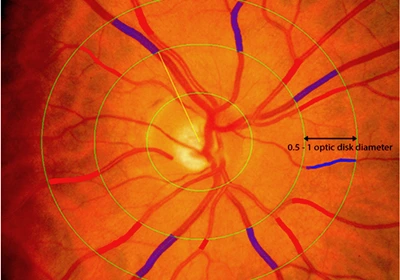
Static retinal vessel analysis was performed non-invasively by digital fundus photography, which measures retinal arteriolar and venular diameters. The measurement area was located 0.5 to 1 disc diameter from the optic disc rim. All arterioles and venules within this zone were semi-automatically detected and labelled. The software calculated the average calibre of retinal arterioles and venules, expressed as the central retinal arteriolar equivalent (CRAE), central retinal venular equivalent (CRVE), and arteriolar-to-venular ratio (AVR). These measurements enable characterization of retinal microvascular structure and provide non-invasive markers of early microvascular alterations.
Dynamic Vessel Analyzer, which assesses flicker light–induced vasodilation, was used for dynamic retinal vessel analysis. The software automatically calculated mean arteriolar and venular flicker light–induced dilation (aFID and vFID) and arteriolar constriction (aCON). Dynamic assessments of vascular calibre and responsiveness reflect functional endothelial signalling, making them particularly relevant in a condition where functional dysregulation rather than irreversible damage is believed to predominate.
Results
74 children and adolescents aged 7 to 17 years with symptoms of pediatric post-COVID syndrome were recruited between May 2022 and September 2023. 58 static and 59 dynamic retinal vessel analysis recordings met predefined quality criteria. 67 patients (90.5%) returned for follow-up. There was no significant change between baseline and follow-up in symptom burden assessed by the MLCSQ.
The comparison of retinal arteriolar and venular calibers between patients with PCS and healthy controls with identical age, sex, and BMI distribution revealed a distinct retinal microvascular pattern in children and adolescents with PCS. Compared to matched healthy controls, children and adolescents with PCS had markedly higher central retinal arteriolar equivalent and central retinal venular equivalent and an increased arteriolar-to-venular ratio. According to the authors, these findings in the PCS group show a coherent pattern of arteriolar and venular dilation with a disproportionate arteriolar contribution, reflected in an elevated arteriovenous ratio.
Interestingly, diastolic blood pressure was higher in the PCS group and inversely associated with the arteriolar-to-venular ratio. After adjustment for blood pressure, the microvascular alterations observed in the PCS group remained significant, indicating that haemodynamic influence alone cannot fully explain these findings.
In children with PCS, regression analysis revealed a significant association between venular diameters and time interval between the first and follow-up examination. Longer intervals were associated with a greater reduction in central retinal venular equivalent over time. Statistically significant associations were not found for retinal arteriolar equivalent, arteriolar-to-venular ratio, or dynamic vessel parameters.
Conclusion
According to the authors, static and dynamic retinal vessel analysis provides the first in vivo evidence of retinal microvascular alterations in children and adolescents with symptoms of pediatric post-COVID syndrome several months after SARS-CoV-2 infection. They emphasized that vessel dilation in children with PCS, characterised by enlargement of both arterioles and venules with a disproportionate arteriolar contribution, suggests persistently altered microvascular regulation (vascular tone and vasomotor responsiveness) rather than fixed structural alteration.
The authors concluded that retinal imaging may represent a useful, non-invasive approach for assessing microvascular involvement in this context. Further longitudinal studies are required to validate these findings, better characterise temporal patterns, and determine whether retinal vascular parameters may serve as markers of disease course in children and adolescents with PCS. Given the fundamental role of the microcirculation and endothelial function in the regulation of tissue perfusion, microvascularuture may provide earlier insights into systemic diseases than later structural changes such as tissue damage or clinically apparent organ dysfunction. Accordingly, these results may offer important insights into the underlying mechanisms of pediatric post-COVID syndrome.
This article was published in Scientific Reports.
Reference
Lamprecht PS, Streese L, Hauser C et al. Retinal microvascular alterations consistent with endothelial dysregulation in paediatric post-COVID-19 syndrome: A prospective matched-cohort study. Sci Rep 16, 17180 (2026). https://www.nature.com/articles/s41598-026-54086-y
