
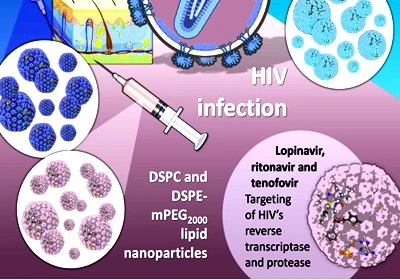
The paramount goal of antiretroviral therapy (ART) is virologic suppression of human immunodeficiency virus (HIV-1), preventing progression of most HIV-associated morbidity and mortality, and HIV transmission. The only currently approved complete long-acting (LA) ART regimen, cabotegravir (CAB) plus rilpivirine (RPV), has significant limitations, including lack of accessibility in resource-limited countries and a high resistance rate to RPV. The Targeted Long-Acting Combination Antiretroviral Therapy program (TLC-ART, University of Washington) is a novel drug platform, capable of co-stabilizing insoluble and soluble antiretrovirals (ARVs), combined in a nano-drug combination suspension. In preclinical models, this drug combination nanoparticle (DcNP) product existed as a stable suspension with longer stability within mononuclear cells than in plasma. The first formulation (TLC-ART 101) combines three US FDA–approved antiretrovirals available globally: the protease inhibitors lopinavir (LPV) and ritonavir (RTV), used as a booster in oral formulation, and the nucleotide reverse transcriptase inhibitor tenofovir (TFV). In this first human trial, the authors from the United States investigated pharmacokinetic (PK) and safety characteristics of a lipid nanoparticle containing lopinavir, ritonavir, and tenofovir (designed for human immunodeficiency virus treatment) as a single injectable suspension
About the study
All participants were healthy volunteers without human immunodeficiency virus or viral hepatitis, without any significant underlying medical conditions and taking no daily medications at study entry. The planned study size was 12-16 participants, with each cohort comprising 4 participants, allowing for an additional 4 participants at the final selected dose.
TLC-ART 101, a sterile injectable suspension containing LPV, RTV, and TFV together as a DcNP contained per milliliter: LPV (10.4 mg) RTV (2.8 mg), TFV (6.1 mg), and the lipid excipients disearoylphosphotidylcholine (DSPC, 115.5 mg) and methoxy-polyethylene glycol-1,2-distearoyl-sn-glycero-3-phosphoethanolamine (mPEG2000-DSPE, 46.0 mg). The initial dose of 1.5 mL containing 15.6 mg LPV, 4.1 mg RTV, and 9.2 mg TFV was selected based on nonhuman primate models. After the initial cohort enrolled in the study, study enrollment was paused, and plasma drug concentrations were determined. The study team and data monitoring committee selected the subsequent dose after a safety and pharmacokinetic review.
The co-primary outcomes were the plasma concentrations and pharmacokinetics of the three drugs (LPV, RTV, and TFV) after a single subcutaneous injection of TLC-ART 101, as well as safety and tolerability of TLC-ART 101. Before administration of TLC-ART 101, plasma and peripheral blood mononuclear cells (PBMCs) were collected at 15, 30, and 45 minutes post-dosing, at 1, 3, 5, 8, and 24 hours; and after 2, 3, 7, 10, 14, 21, 28, 35, 49, and 57 days. LPV quantitation in plasma was assessed using liquid-liquid extraction and high-performance liquid chromatography with tandem mass spectrometry detection (LC-MS/MS). Intracellular drug concentrations in PBMCs were converted to nanograms per milliliter. Inguinal lymph node excision was performed in two participants. Concentrations of lopinavir, ritonavir, and tenofovir in lymph node mononuclear cells (LNMCs) were quantified as in PBMCs.
Results
The study included four women and 8 men, with a median age of 34 (range, 24–58) years. All participants completed the study. Two participants underwent the optional lymph node biopsy 24 hours after drug administration.
Pharmacokinetic data
Participants received a single dose of drugs: 10.4 mg of lopinavir (LPV), 2.7 mg of ritonavir (RTV), and 6.1 mg of tenofovir per milliliter of TLC-ART 101. The low-dose cohort (n = 4) received a single 1.5-mL injection; the mid-dose cohort (n = 3) received 2 × 1.5-mL injections (3 mL); and the high-dose cohort (n = 5) received 2 × 2-mL injections (4 mL). The trial duration was 57 days for the low-dose cohort and 64 days for both the mid- and high-dose cohorts. For all 3 drugs, an initial burst with higher concentrations, followed by a second slower phase of decay, was observed.
The half-life of lopinavir (LPV) within the TLC-ART 101 formulation was 11 (9–16) days in the low-dose cohort, 72 (32–146) days in the mid-dose, and 17 (10–33) days in the high-dose cohort. LPV was detectable in plasma in almost all participants through the end of the study.
The half-life of ritonavir (RTV) within TLC-ART was 0.4 (0.3–0.8) days in the low-dose cohort, 2.7 (0.5-4.4) days in the mid-dose cohort, and 0.5 (0.3–0.7) days or approximately 12 hours in the high-dose cohort, or about twice as long as oral 200 mg daily dosing. Across all 3 cohorts, RTV was last detected at a median of 2 (range, 1-7) days. These results show that LPV was detectable through 2 months in most participants and that plasma RTV was rapidly cleared. A median plasma half-life of tenofovir (TFV) was 3.5 days (range, 1.5–3.8) in the high-dose cohort. It was longer than in the low-dose (range, 0.8–5 days) and mid-dose (range, 0.5–4 days) cohorts.
Intracellular concentrations of all 3 drugs in PBMCs and lymph nodes were much higher than in plasma. LPV plasma concentrations were maintained for a short time above the reported minimum inhibitory concentration of free LPV against HIV-1; however, most participants maintained intracellular LPV concentrations above the IC50 for days or weeks.
Clinical Safety
Hypersensitivity with variable manifestations was observed in 5 of 12 participants. A single case of anaphylaxis occurred 6 hours after dosing in one participant. One participant (low-dose) reported unilateral lip swelling approximately 15 hours after dosing. A different high-dose participant experienced a diffuse, confluent erythematous truncal rash (grade 2), accompanied by new-onset nausea and back tightness approximately 6 hours after dosing. Two additional participants experienced generalized pruritus without rash less than 24 hours after dosing. Three participants had grade 2 erythema. Any pain, discomfort, or tenderness was reported at a median of 6 days,
The authors suggested non-IgE-mediated mechanisms of immune activation because neither the participant with anaphylaxis nor any of the other four with systemic manifestations of hypersensitivity had increased IgE or tryptase. Because TLC-ART contains mPEG2000-DSPE, these lipid excipients could plausibly trigger hypersensitivity not predicted by previous animal models unexposed to polyethylene glycol.
Conclusion
This first-in-human study tested a lipid nanoparticle combining soluble and insoluble antiretrovirals in a single injection. Results showed long detection of lopinavir in plasma and intracellular compartments for 2 months. In contrast, the drug ritonavir was rapidly eliminated.
This article was published in The Journal of Infectious Diseases.
Journal Reference
Rachel A Bender Ignacio, Christine Jonsson, Simone Perazzolo, et al. A Novel Injectable Drug Combination Nanoparticle Containing 3 Antiretrovirals Designed for Human Immunodeficiency Virus Treatment: A First-in-Human Trial. The Journal of Infectious Diseases, 2026, jiag504. (Open Access). https://doi.org/10.1093/infdis/jiag504
