
The human microbiome consists of trillions of microorganisms, primarily residing in the gastrointestinal (GI) tract, where they perform critical functions such as fermenting indigestible fibers, regulating immune responses, synthesizing vitamins, aiding energy metabolism, and maintaining gut barrier integrity. Dysbiosis, or chronic microbial imbalance, has been linked to various health issues, including cardiovascular diseases (CVD). The gut microbiota exerts its systemic influence through compositional changes and the production of bioactive metabolites, such as short-chain fatty acids (SCFAs), trimethylamine-N-oxide (TMAO), and indoxyl sulfate (IS), which are linked to coronary artery disease (CAD). In this review, the authors from Switzerland and Germany analyzed current evidence on the interplay among sex differences, coronary artery disease, and the gut microbiota.
Numerous studies indicate sex-related differences in microbial composition. Certain microbial taxa and metabolite activities differ between men and women, which, in turn, affects disease processes. Data have not shown clear sex differences in overall microbiota heterogeneity or diversity. However, sex-specific differences were noted in microbial composition, such as the abundance of Bacteroidota and Bacillota. Sex-dependent species interactions and core microbial species suggest that men and women may have unique microbiota compositions with potential implications for their health. Understanding these differences is essential for explaining sex-based discrepancies in diseases like atherosclerosis.
The gut microbiota plays a crucial role in transforming dietary nutrients into bioactive molecules, among which trimethylamine-N-oxide (TMAO) has drawn significant attention for its potential role in promoting atherosclerosis. TMAO is generated from trimethylamine (TMA), a metabolite produced by the gut microbiota through the breakdown of choline and L-carnitine. The conversion of choline and carnitine to TMAO is highly dependent on the composition and balance of the gut microbiota. TMAO levels tend to be higher in men with stable coronary artery disease, particularly with advancing age, and are elevated in women during acute myocardial infarction. Indoxyl sulfate (IS) is a uremic toxin derived from microbial tryptophan metabolism. It plays a critical role in vascular pathology, impairing the viability of endothelial and smooth muscle cells, inhibiting proliferation and migration, and promoting apoptosis and plaque formation.
The gut microbiota plays a crucial role in transforming dietary nutrients into bioactive molecules, among which trimethylamine-N-oxide (TMAO) has drawn significant attention for its potential role in promoting atherosclerosis. TMAO is generated from trimethylamine (TMA), a metabolite produced by the gut microbiota through the breakdown of choline and L-carnitine. The conversion of choline and carnitine to TMAO is highly dependent on the composition and balance of the gut microbiota. TMAO levels tend to be higher in men with stable coronary artery disease, particularly with advancing age, and are elevated in women during acute myocardial infarction. Indoxyl sulfate (IS) is a uremic toxin derived from microbial tryptophan metabolism. It plays a critical role in vascular pathology, impairing the viability of endothelial and smooth muscle cells, inhibiting proliferation and migration, and promoting apoptosis and plaque formation.
About the study
The authors conducted a scoping review to map current evidence on the interplay between sex differences, coronary artery disease, and gut microbiota. A review included observational studies with different designs (cross-sectional, case–control, prospective, and retrospective cohort studies) and intervention studies with baseline data, involving human participants. These studies included adults aged 18 years or older.
Eligible studies used 16S rRNA sequencing, shotgun metagenomics, or metabolite profiling to analyze microbial communities and atherosclerosis-associated metabolites. Mechanistic links from genetics, epigenetics, and hormone-microbiota interactions were integrated to provide a more comprehensive understanding of how gut microbiota may contribute to sex-based differences in CAD.
Information on gut microbiota included composition and diversity (e.g., alpha and beta diversity) and taxonomic abundance at various levels (e.g., phylum, genus, species). Alpha (α) diversity measures the variation of gut microbiota within a single sample, considering both the richness of species and their relative abundance, whereas beta (β) diversity evaluates the differences or similarities in microbial communities between groups. Bacterial species were also categorized according to various characteristics, such as phylogeny, metabolic functions, environmental preferences, morphology, and genetic sequence.
Data on gut microbiota composition also included the composition of gut microbiota metabolites in serum or plasma, such as TMAO, secondary bile acids, short-chain fatty acids (SCFAs), tryptophan, and indole derivatives.
Results
Following primary screening, 48 studies were selected for full-text review. Eleven studies met the inclusion criteria: seven examined differences in gut microbiota composition or metabolite profiles between men and women, and four contained sub-analyses.
Male and female patients with coronary artery disease exhibit distinct gut microbiota compositions and metabolites. The microbial profile of men with coronary artery disease is characterized by specific taxa, such as Clostridia UGC, Erysipelotrichaceae, and Prevotella. Clostridia UCG-014, Prevotella, and members of the Erysipelotrichaceae family have been implicated in proinflammatory activity and compromised gut barrier integrity. Prevotella, in particular, has been associated with increased intestinal permeability and heightened production of proinflammatory cytokines, thereby potentially contributing to the initiation and progression of atherosclerosis. The Erysipelotrichaceae family has also been associated with proinflammatory responses.
Women with coronary artery disease showed an enrichment in Actinobacteriota and Bifidobacterium. Bifidobacterium species are considered protective because of their role in maintaining gut barrier function and modulating anti-inflammatory pathways. However, because these data relied on a single study that specifically examined gut microbiota in male and female patients with coronary artery disease, the authors suggested that additional studies with larger, well-characterized cohorts are needed to corroborate these findings.
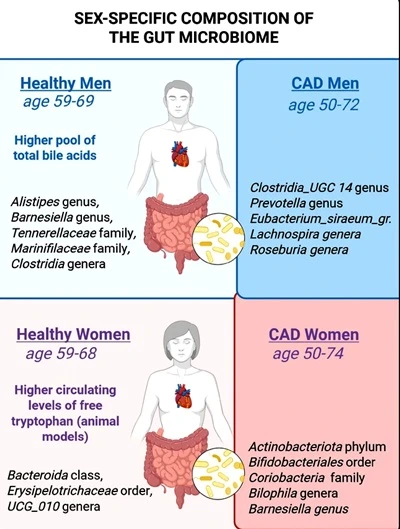
Original figure from Chong-Nguyen et al. Biol Sex Differ 17, 24 (2026).
Sex-specific differences were also observed in gut-derived metabolites: men had higher levels of TMAO, indoxyl sulfate, and acetate, while women exhibited higher levels of secondary bile acids and lower levels of TMAO. These results raise important questions about the underlying mechanisms driving sex-specific differences in TMAO metabolism. An increased abundance of Clostridia species, known producers of IS, in men with coronary artery disease may underlie some of the observed sex differences, particularly in atherosclerosis development. Elevated IS in men, potentially driven by Clostridia enrichment, may help explain their heightened susceptibility to atherosclerosis. The microbial profile of men with coronary artery disease was characterized by specific taxa such as Prevotella, which is known to be a high-capacity producer of TMA. In contrast, Bifidobacterium species, found in women with coronary artery disease, have been reported to be negatively correlated with TMAO.
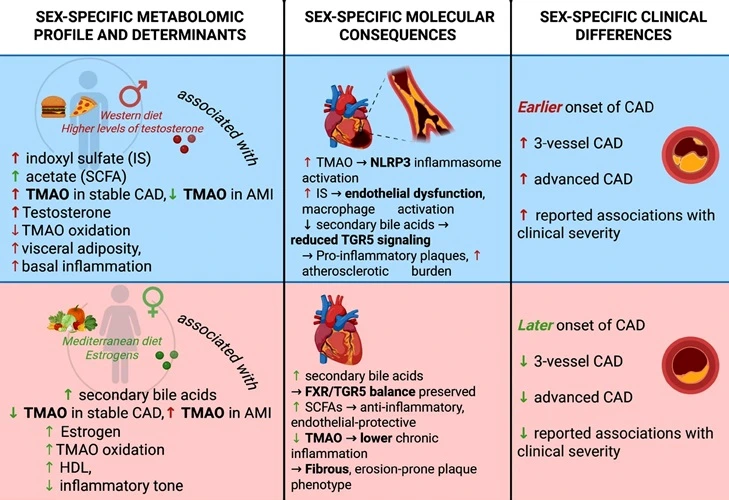
Original figure from Chong-Nguyen et al. Biol Sex Differ 17, 24 (2026).
Conclusion
These findings suggest that men and women exhibit distinct microbial compositions and metabolite profiles, with men showing enrichment of pro-inflammatory, TMA/TMAO-producing taxa such as Prevotella and Clostridia, and women harboring SCFA-producing, barrier-supporting microbiota such as Bifidobacterium. This review integrates emerging mechanistic hypotheses linking gut microbial composition, metabolites, and sex-specific coronary artery disease phenotypes, although most evidence remains correlative.
This article was published in Biology of Sex Differences.
Journal Reference
Chong-Nguyen, C., Fuentes Artiles, R., Pilgrim, T. et al. The gut–heart axis in coronary artery disease: a scoping and narrative review of sex-based microbial and metabolic disparities. Biol Sex Differ 17, 24 (2026). https://link.springer.com/article/10.1186/s13293-026-00824-w
